Currently Empty: ₹0.00



SAP MyVatika | Organic Manure & Soil Health | ~5 min read
Both vermicompost and cow dung compost are genuinely good for plants. They’re both organic, both widely used across India, and both improve soil in ways that chemical fertilizers simply don’t. But they work differently, they suit different situations, and knowing which one to use — and when — makes a real difference to how your plants respond.
This isn’t a complicated question but it’s one that comes up constantly from home gardeners, nursery owners, and farmers who want to do right by their soil without spending more than they need to.
Here’s a straightforward comparison.
What is vermicompost and how is it made?
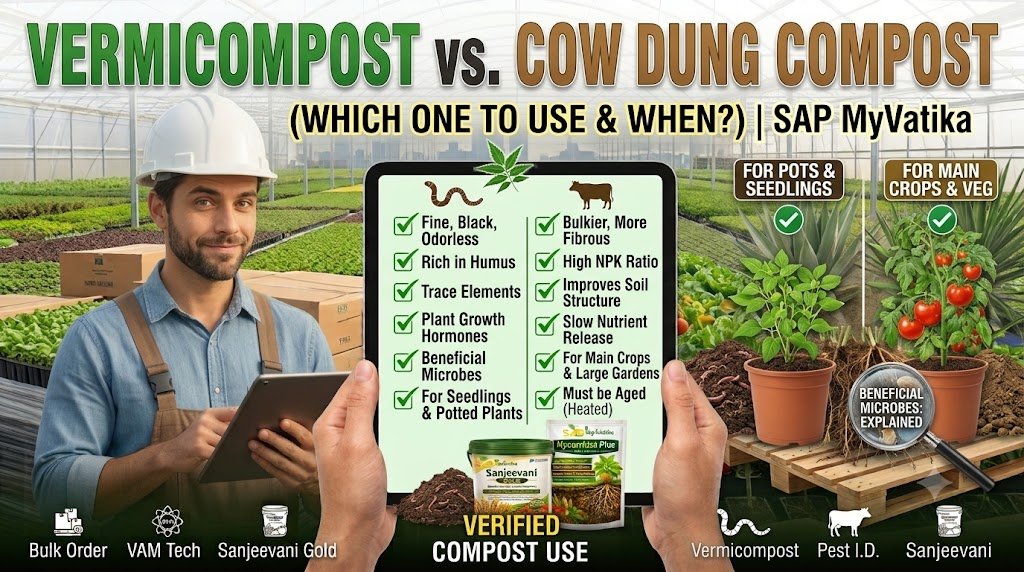
Vermicompost is compost produced by earthworms — specifically by feeding organic waste through a worm bed and collecting the castings the worms leave behind. The process is faster than traditional composting and produces a final product that is finer in texture, higher in available nutrients, and richer in beneficial microorganisms than most other organic inputs.
The nutrient profile of good vermicompost sits around 2–3% nitrogen, 1.5–2% phosphorus, and 1.5–2% potassium — along with a wide range of micronutrients and beneficial bacteria and fungi that support plant health at the root level.
Because it’s processed through the worm’s digestive system, the nutrients in vermicompost are in a form that plant roots can access much more quickly than nutrients in raw or partially decomposed organic matter. This is the key difference from cow dung compost — vermicompost is ready to use from the moment it leaves the worm bed.
What is cow dung compost and how is it different?
Cow dung compost — sometimes called gobar khad — is made by composting cattle dung, either alone or mixed with crop residue, straw, and other farm waste. It’s been used in Indian agriculture for centuries and for good reason. Fully decomposed cow dung compost improves soil structure, adds organic carbon, and feeds soil biology in ways that keep soil productive over the long term.
The nutrient content is lower than vermicompost — typically around 1–1.5% nitrogen, 0.5–1% phosphorus, and 0.5–1% potassium. But what cow dung compost does exceptionally well is improve the physical properties of soil. It opens up compacted soil, improves water retention, and creates conditions where other inputs — including chemical fertilizers — work more efficiently.
The key word in all of this is fully decomposed. Raw or partially decomposed cow dung generates heat as it breaks down and can burn plant roots if applied directly. Always check that the cow dung compost you’re buying is fully cured and ready to use. SAP MyVatika’s Cow Dung Compost is fully composted and quality checked before dispatch — which is something worth verifying with any supplier.
The practical differences — side by side
Nutrient availability is the first difference. Vermicompost releases nutrients faster and in a more plant-available form. Cow dung compost releases nutrients more slowly over a longer period. For plants that need a quick nutritional boost — seedlings, plants recovering from stress, or crops at a critical growth stage — vermicompost is the faster-acting choice.
Soil improvement is the second. Both improve soil biology and structure but cow dung compost does this more significantly at a physical level. It breaks up clay soils, adds bulk to sandy soils, and improves water retention in a way that vermicompost alone doesn’t match — particularly in large-scale applications where you’re working with big volumes of soil.
Cost is the third. Cow dung compost is generally cheaper than vermicompost — especially at bulk quantities. For large-scale soil preparation where you need to cover a wide area, cow dung compost is the more cost-effective choice. Vermicompost is more concentrated so you use less of it, but per kilogram it costs more.
Texture and application are the fourth. Vermicompost has a fine, crumbly texture that works well in pots, seedling trays, and indoor plant mixes. Cow dung compost is coarser and better suited to open soil, garden beds, and field application.
When to use vermicompost
Use vermicompost when you need faster nutrient availability and a concentrated biological boost.
For seedlings and young plants — vermicompost mixed into the seed-starting or transplanting mix gives young plants access to nutrients and beneficial microorganisms from day one. The fine texture doesn’t compact around delicate roots and the fast-release nutrient profile supports rapid early growth.
For potted indoor plants and terrace gardens — where soil volume is limited and plants depend entirely on what’s in the pot, vermicompost provides a richer, more biologically active growing medium than cow dung compost. Mix 20–30% vermicompost into your potting mix for most indoor plants.
For vegetable crops at key growth stages — applying vermicompost as a top dressing around the base of vegetable plants at flowering and fruiting stage gives a quick nutritional boost exactly when the plant needs it most.
For plants recovering from stress — disease, transplant shock, or drought stress. The beneficial microorganisms in vermicompost help restore soil biology around the root zone and support faster recovery.
When to use cow dung compost
Use cow dung compost when you’re working at scale, preparing soil before planting, or trying to improve the physical structure of your soil over time.
For large-scale soil preparation — whether it’s a field before sowing, a nursery bed, or a landscaping project, cow dung compost is the most cost-effective way to add organic matter across a wide area. Mix into the top 6–8 inches of soil before planting.
For improving compacted or poor-quality soil — clay-heavy soils that waterlog easily and sandy soils that dry out too fast both benefit significantly from cow dung compost. The organic matter it adds improves drainage in clay and water retention in sand.
For fruit trees and plantation crops — where the goal is long-term soil health rather than quick-release nutrition, cow dung compost applied as an annual mulch around the base of trees builds the organic matter and microbial activity that keep orchards productive over many years.
For kitchen gardens and home garden beds — mixed into the soil before planting each season, cow dung compost maintains the organic matter level that keeps garden soil easy to work and productive without heavy fertilizer input.
Can you use both together?
Yes — and this is actually the approach that works best for most situations.
Cow dung compost for the base layer — mixed into soil before planting to improve structure and add bulk organic matter. Vermicompost for the top dressing or plant hole application — placed directly in the root zone where the plant can access its faster-releasing nutrients from the start.
For home gardeners mixing their own potting soil, a combination of cow dung compost for structure and vermicompost for nutrition gives you a growing medium that’s significantly better than either one alone. A rough guide is 30% cow dung compost, 20% vermicompost, and the rest cocopeat or garden soil depending on your plants.
For large-scale farmers, the same principle applies at field level — cow dung compost during soil preparation, vermicompost as a targeted application around seedlings or at critical growth stages.
The honest bottom line
If you only have budget for one — cow dung compost is the better choice for large areas and long-term soil building. Vermicompost is the better choice for pots, seedlings, and situations where you need faster nutrient response.
If budget allows, using both together gives you soil that performs better than either input alone — and over two or three seasons, the cumulative improvement in soil health is visible and measurable.
Both are available from SAP MyVatika in retail packs and bulk with wholesale pricing. Pan-India delivery in 3–5 business days.
📞 Order online: sapmyvatika.com
🌿 Kisan Helpline: 7303037568
✅ ICAR Recommended | DPIIT Recognised | ISO 9001:2015 Certified